Quick Guide
- What Does Differential Fluid Actually Do?
- What Does Transmission Fluid Do? (It's More Than Just Lube)
- Differential Fluid vs Transmission Fluid: Key Differences at a Glance
- The Million-Dollar Question: Can You Mix or Substitute Them?
- Checking and Changing: What You Need to Know
- Answers to Your Burning Questions (FAQs)
- Making the Right Choice: A Simple Checklist
Let's talk about something that confuses a lot of car owners, even some who are pretty handy under the hood. You're probably here because you heard both terms, maybe during a service, or you're staring at bottles in an auto parts store wondering if they're the same thing. I've been there. The short, non-negotiable answer? Differential fluid and transmission fluid are absolutely not the same. Using one for the other is a shortcut to a very expensive repair bill.
Think of it like this: your body needs both blood and stomach acid. Both are vital fluids, but swapping them would be... catastrophic. It's a similar principle in your car's drivetrain. The confusion is understandable—they're both lubricants that live in metal housings somewhere between the engine and the wheels. But their jobs, the stresses they face, and the recipes needed to do those jobs are worlds apart.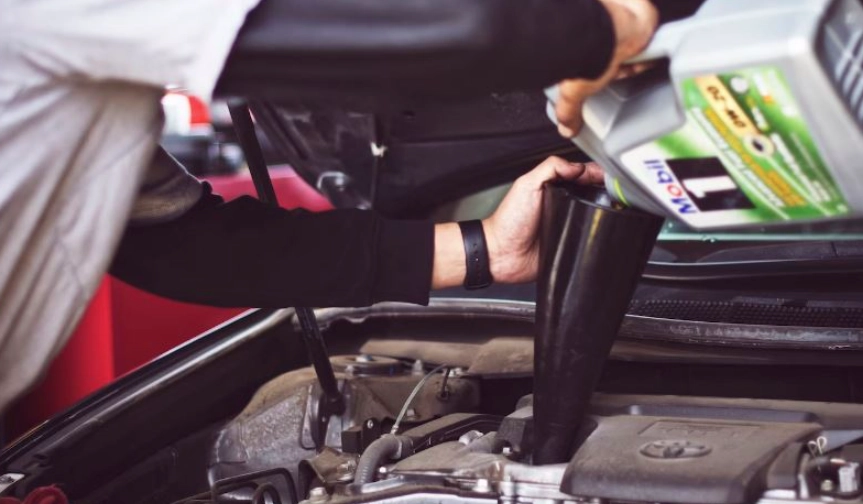
What Does Differential Fluid Actually Do?
First, let's clear up what a differential even is. If you've ever watched a car take a tight corner, you'll notice the inside wheel travels a shorter distance than the outside wheel. The differential is the genius bit of gearing (usually in that bulky pumpkin-shaped housing on your axle) that allows the wheels to rotate at different speeds while still receiving power.
Differential fluid, often called gear oil, has one brutal, heavy-duty job: it lubricates a set of hard-meshing, high-pressure gear teeth (the ring and pinion, and the spider gears inside). These gears are under immense shear force—the kind of force that wants to tear molecules apart. The fluid forms a protective film to prevent metal-to-metal contact.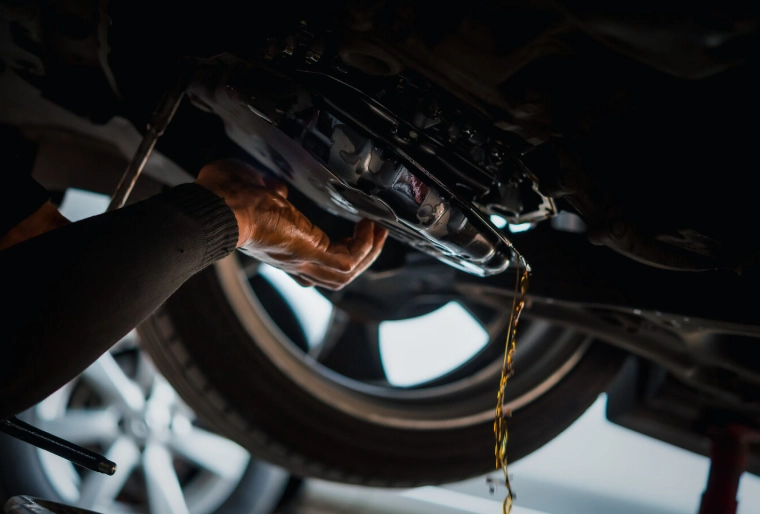
It also has to handle extreme pressure. When you accelerate hard, all that torque from the engine gets multiplied and focused onto those small contact points between gear teeth. The fluid needs additives, specifically Extreme Pressure (EP) additives, to prevent welding and pitting. You'll often see ratings like GL-5, which is a specification by the SAE (Society of Automotive Engineers) denoting a gear oil with robust EP protection.
Heat is a factor too, but it's more about heat from friction under load than from a complex hydraulic system. The environment in a differential is relatively simple but mechanically violent.
What Does Transmission Fluid Do? (It's More Than Just Lube)
Now, the transmission is a whole different beast. Whether it's a manual or an automatic, its job is to change gears, but how it does that dictates what the fluid needs to accomplish. This is where the differential fluid vs transmission fluid comparison gets interesting.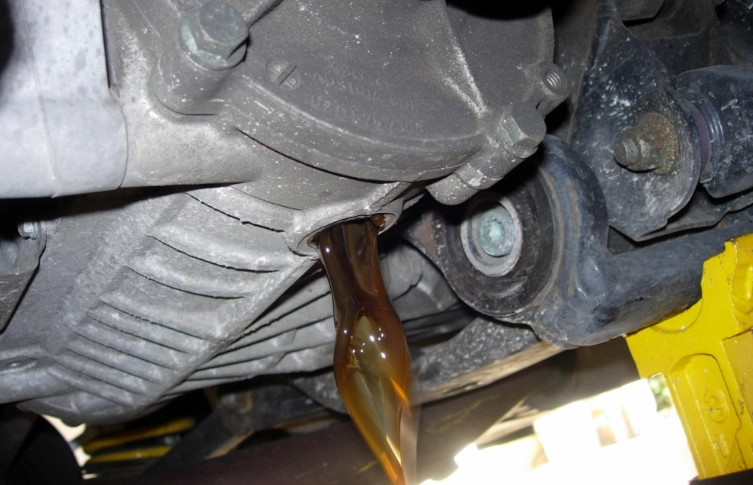
Automatic Transmission Fluid (ATF)
ATF is a multi-talented hydraulic fluid. Its list of duties is long:
- Lubrication: Like differential fluid, it coats gears and bearings.
- Power Transmission: This is the big one. In an automatic, the engine isn't physically connected to the gears by a clutch. The connection is made through a torque converter, which uses fluid dynamics to transfer power. The ATF is the medium that makes this happen.
- Hydraulic Pressure: It acts as the hydraulic fluid for the valve body—the "brain" of the transmission—to engage clutches and bands that shift gears.
- Cooling: It carries heat away from the clutches and torque converter to the transmission cooler.
- Cleaning: It holds detergents and dispersants to keep varnish and debris in suspension.
See the difference? Differential fluid is a specialized lubricant. ATF is a lubricant, hydraulic fluid, coolant, and cleaning agent all in one. It needs a much more delicate balance of friction modifiers (so clutches engage smoothly without slipping), viscosity stabilizers, and anti-foam agents. The specifications are incredibly tight. Using the wrong ATF can lead to harsh shifts, clutch slippage, or a transmission that just refuses to work.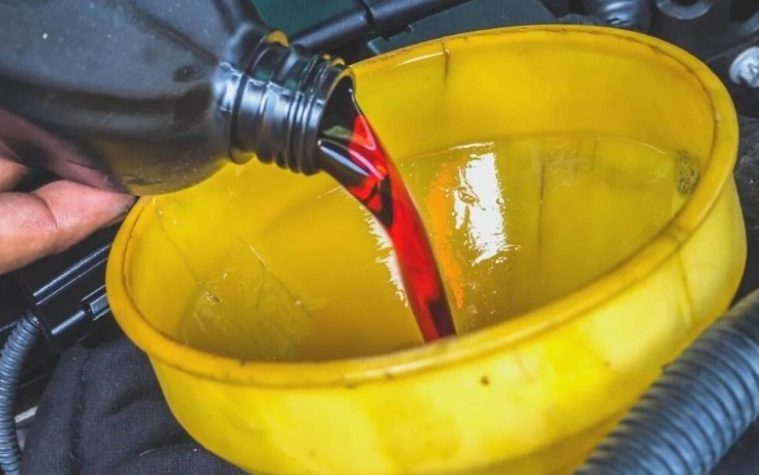
Manual Transmission Fluid
Manual gearbox fluid sits somewhere in the middle. It doesn't have the hydraulic duties of ATF, but it often lubricates synchronizers (which help match gear speeds for smooth shifts). These synchros are often made of brass or carbon, which can be sensitive to the EP additives in heavy-duty gear oil. Some manuals use a specific manual transmission fluid, some use a lighter gear oil (like GL-4), and some older, robust boxes can use GL-5. You must check your owner's manual.
Differential Fluid vs Transmission Fluid: Key Differences at a Glance
Okay, let's lay this out side-by-side. This table should make the difference between differential and transmission fluid crystal clear.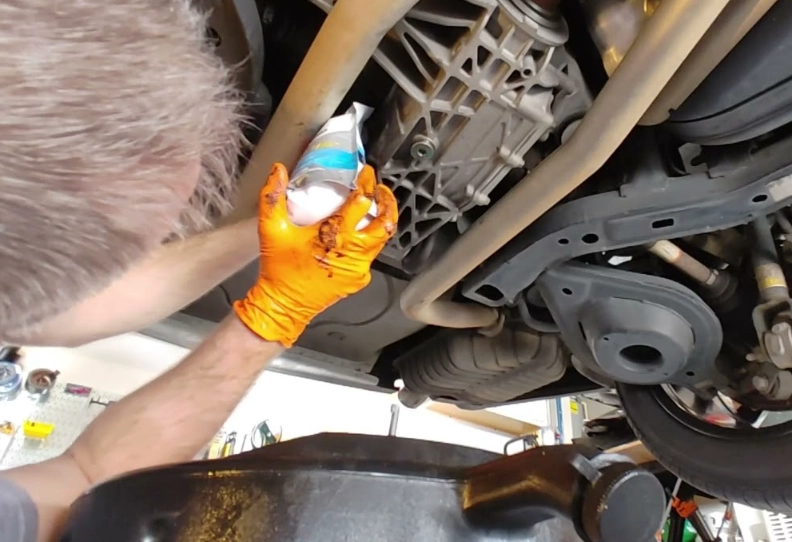
| Feature | Differential Fluid (Gear Oil) | Automatic Transmission Fluid (ATF) |
|---|---|---|
| Primary Function | Extreme pressure lubrication of hypoid gears. | Lubrication, hydraulic power transfer, clutch engagement, cooling. |
| Key Additives | Extreme Pressure (EP) additives (sulfur-phosphorus compounds). High concentration. | Friction modifiers, anti-wear, detergents, dispersants, viscosity index improvers. Balanced, specific formulation. |
| Viscosity | Typically thicker (e.g., 75W-90, 80W-140). High viscosity to maintain film strength. | Typically thinner (e.g., equivalent to ~5W-20 or 10W-30 motor oil). Must flow quickly for hydraulic functions. |
| Friction Properties | Designed for constant, high friction between gear teeth. | Contains precise friction modifiers for smooth clutch engagement (not too slippery, not too grabby). |
| Compatibility with Metals | Formulated for steel gears. EP additives can corroce yellow metals (brass, bronze, copper). | Safe for a wide range of metals, including clutch plates, bushings, and brass components. |
| Change Interval | Longer intervals, often 30,000 to 60,000 miles, but severe use shortens this. | More frequent, often 30,000 to 60,000 miles for drain-and-fill, but varies hugely. "Lifetime" fluid is a controversial topic. |
| Common Specifications | API GL-5, GL-4. Some manufacturer-specific. | Dexron, Mercon, ATF+4, Type T, WS, etc. Very specific to manufacturer. |
Staring at that table, the distinction should be pretty solid now.
The Million-Dollar Question: Can You Mix or Substitute Them?
No. Just no.
Let's break down the disasters that await if you confuse differential fluid and transmission fluid.
Putting Differential Fluid (Gear Oil) in an Automatic Transmission: This is a death sentence. The thick gear oil will clog the delicate valve body passages, preventing hydraulic pressure from building. The transmission won't shift. The friction modifiers are all wrong, causing clutches to chatter, slip, or burn out almost instantly. The sulfurous EP additives will attack and corrode soft metal seals and components. You'd be lucky to make it home.
Putting ATF in a Differential: This is a slower, but equally sure, death. The thin ATF cannot form the high-strength film needed between the gear teeth. You'll get metal-to-metal contact. The gears will wear rapidly, leading to pitting, scoring, and eventually, catastrophic failure with a loud bang. It might take a few hundred or thousand miles, but it will happen.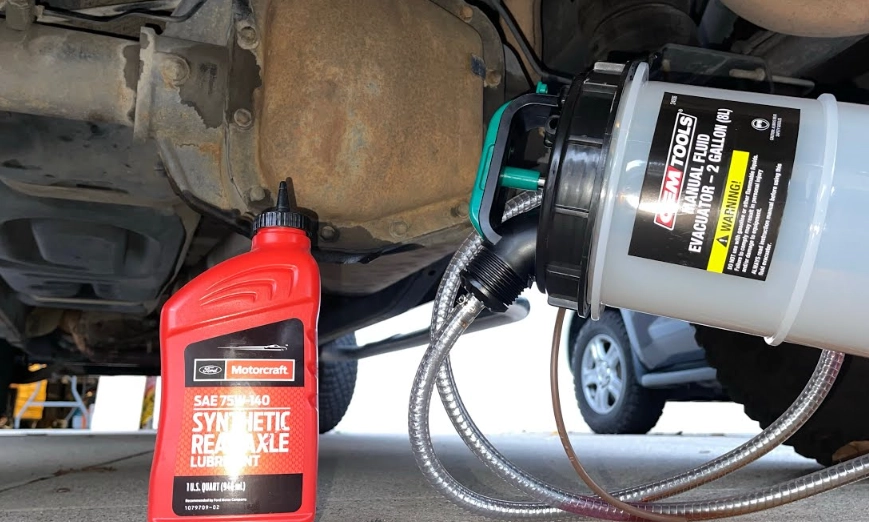
Checking and Changing: What You Need to Know
Maintenance is where this knowledge becomes practical. The intervals can be confusing because they're so broad.
Differential Fluid Service
Differentials are often the "forgotten" component. Many people never change the fluid. It's a sealed unit with no filter, so contaminants and metal wear particles just swim around in there forever, acting like sandpaper. Not ideal.
- When to change it? Severe service is the key. Do you tow, haul heavy loads, drive in deep water (which can contaminate the fluid through the breather), or do a lot of stop-and-go driving? If so, cut the "normal" interval in half. For a typical car, every 50k miles is a good safety net. For a truck that works, 30k miles is smarter.
- How to check it? Most diffs have a fill plug on the side of the housing. The fluid level should be at the bottom of this hole. It's messy. The fluid should be relatively clear, not black, and shouldn't smell burnt. Grit on the magnetic drain plug is normal; large metal chunks are a very bad sign.
Transmission Fluid Service
This is a hotter topic. The debate over "lifetime" fluid is endless. My take? There's no such thing as a lifetime fluid in a mechanical system that generates heat and wear. "Lifetime" to a manufacturer often means the warranty period.
- When to change ATF? Follow your manual, but lean towards the severe service schedule if you do anything beyond gentle highway cruising. A drain-and-fill (which only replaces 30-50% of the fluid) every 30k-40k miles is a conservative, safe practice for most vehicles. Avoid aggressive "flush" machines unless recommended by the manufacturer; they can dislodge debris and cause problems.
- How to check it? This is crucial. With the engine running and the transmission at operating temperature (after a drive), pull the dipstick (if you have one—many new cars don't). The fluid should be in the "hot" range. Color and smell are key: it should be red or reddish-brown, not dark brown or black. It should smell slightly sweet or oily, not burnt. Burnt smell = trouble.
You can find the official maintenance schedules for your specific vehicle on the manufacturer's website, like Toyota Owners or Ford Support. Don't rely on generic advice.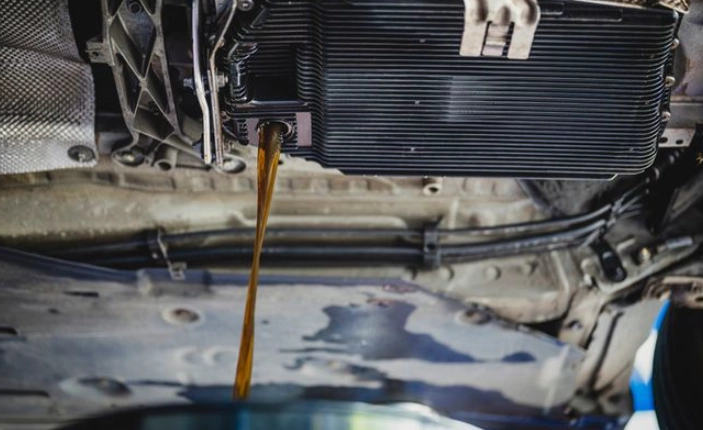
Answers to Your Burning Questions (FAQs)
1. A front differential (in the axle).
2. A rear differential.
3. A transfer case (which splits power front/rear).
All three may require different fluids! The front and rear diffs might take gear oil, but of different weights (e.g., 75W-90 front, 75W-140 rear for towing). The transfer case might require ATF or a specific transfer case fluid. Consulting the manual or a service guide like those on ALLDATA is non-negotiable here.
Making the Right Choice: A Simple Checklist
Before you buy anything, run through this list. It'll save you headaches.
- Consult the Owner's Manual: This is your bible. Not a forum, not a friend, not the guy at the parts store (unless he looks it up in a reliable database). The manual has the final say on type and weight.
- Identify the Component: Are you filling the rear differential? The front differential? The transmission? The transfer case? Know exactly which box you're opening.
- Decode the Specification: The manual will say something like "API GL-5 75W-90" or "ATF Type T-V." Match this exactly on the bottle's label. Don't settle for "meets or exceeds." For critical fluids, I prefer to get the exact OEM fluid from the dealer for the first change, so I know it's right.
- Consider Your Driving: If you fall under "severe service," plan on changing fluids more often, and consider a higher-quality synthetic option that meets the spec.
It seems like a lot, but it becomes second nature.
So, the next time you're faced with the differential fluid vs transmission fluid dilemma, you won't have one. You'll know they are fundamentally different fluids engineered for fundamentally different battles inside your car. One protects against crushing pressure, the other manages a delicate dance of hydraulics and friction. Using the right one is a small act that pays off in thousands of miles of smooth, reliable driving. And honestly, avoiding that sickening feeling of a major mechanical failure is worth every bit of this homework.