You turn on your portable air conditioner, expecting a blast of cool relief, but all you get is lukewarm air or just plain fan noise. It's frustrating, especially on a hot day. Before you assume the worst or call for expensive repair, know this: most portable AC cooling failures have simple, fixable causes. I've been fixing these units for years, and the problem is rarely the catastrophic one you fear. This guide walks you through every possible reason, from the obvious to the often-overlooked, in the order you should check them.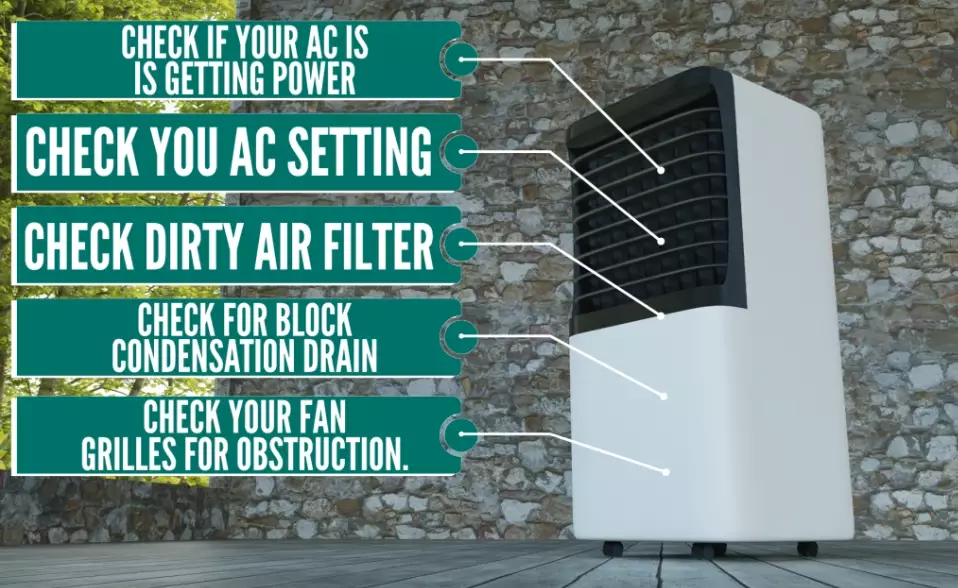
What's Inside This Guide?
Check the Thermostat First
It sounds silly, but you'd be surprised how often this is the issue. You might have bumped the controls or forgotten last season's setting. Make sure the unit is set to "Cool" mode, not just "Fan." The fan mode only circulates air without activating the compressor and refrigeration cycle.
Next, look at the temperature setting. Is it set lower than the current room temperature? If you set it to 75°F and the room is already 74°F, the compressor won't kick on. Try setting it to its lowest possible temperature (like 60°F or 64°F) to force a cooling cycle. Listen closely. When the compressor starts, you'll hear a distinct click and a deeper humming or vibrating sound—different from the gentle whir of just the fan.
A Dirty Air Filter is the #1 Culprit
This is, hands down, the most common reason for poor cooling performance. A clogged filter restricts airflow over the cold evaporator coils. The coils then freeze over, turning into a block of ice that actually insulates and stops cooling. The unit might even blow cold air for a few minutes before the ice builds up and stops it.
How to Clean Your Portable AC's Air Filter?
Locate the filter panel—usually on the back, side, or front behind a grille. Slide the filter out. Hold it up to a light. If you can't see light passing through easily, it's too dirty.
Vacuum it thoroughly with a brush attachment. For a deeper clean, rinse it under lukewarm water (never hot). Let it air dry completely for at least 24 hours before reinstalling. Putting a damp filter back in can cause mold and immediate re-freezing.
I see people clean the filter but miss the second layer. Many units have a coarse pre-filter and a finer secondary filter. Check your manual. Cleaning just one isn't enough.
The Hidden Problem: A Clogged Drain Pan
Portable ACs pull moisture from the air, which collects in an internal drain pan or reservoir. Most have an auto-evaporation system that sends this moisture out with the hot exhaust air. But if the drain hole or the internal drain lines get clogged with algae, dust, or mineral scale (especially in hard water areas), the pan overflows.
An overflowing pan can trigger a float switch that shuts off the compressor to prevent water damage. Your AC will run the fan but not cool. Some models will flash an error code for "water full" or "FL," but others just silently stop cooling.
Is Your Window Kit Installed Correctly?
Portable ACs are single-hose or dual-hose. The hose exhausts hot air from the compressor. If your window seal kit has gaps, hot outside air gets sucked right back into the room, fighting your AC. It's like trying to cool a room with the oven door open.
For single-hose models, this is a critical flaw. They already create negative pressure, pulling warm air from other rooms and cracks. A bad window seal makes it impossible to cool effectively.
Go to your window. Feel around the adjustable panel or slider of the window kit. Do you feel hot air streaming in? Use weather stripping, foam tape, or even a towel to seal every single gap. The goal is an airtight seal around the exhaust hose's window attachment.
Is Your Portable AC Low on Refrigerant?
Refrigerant is the lifeblood of the cooling cycle. It's a sealed system—it should never leak or need a "top-up" under normal circumstances. If it's low, there's a leak.
Signs of a Refrigerant Leak:
The unit runs constantly but never reaches the set temperature. The air from the vents is barely cool or room temperature. You might hear a hissing sound (from a larger leak). Often, you'll see ice buildup specifically on the large copper tube (the suction line) coming from the evaporator coil, not just on the coils themselves.
When the Fan Motor Fails
The unit has two fans: one for the room air (evaporator fan) and one for the hot exhaust (condenser fan). If either fails, cooling stops.
- Evaporator Fan Failure: No air blows from the front vents, or it's very weak. The compressor may still run, but with no airflow, the coils freeze instantly.
- Condenser Fan Failure: Air blows from the front, but it's not cold. The compressor overheats and shuts off on a thermal overload switch. You might hear the compressor try to start, click off, try again in a few minutes—a cycle known as "short cycling."
Listen for unusual noises: grinding, screeching, or a hum without movement. A fan motor bearing can seize. Sometimes, debris like a loose leaf or plastic wrap gets caught in the fan blade, stopping it.
Electrical and Power Supply Issues
Portable ACs draw a lot of power (often 8-12 amps). They're sensitive to voltage drops.
Are you using an extension cord? This is a major no-no. Most manuals forbid it. A standard household extension cord can't handle the sustained current, causing voltage drop. The compressor struggles, overheats, and shuts down, while the fan may keep running. Always plug directly into a wall outlet.
Is the circuit overloaded? If your AC is on the same circuit as a refrigerator, microwave, or space heater, the combined load may trip a breaker or cause brownout conditions. Try plugging the AC into a different, dedicated circuit.
Check the power cord for damage. Feel the plug after the unit has been running for 20 minutes. If it's uncomfortably hot, you have a poor connection at the outlet or a failing cord, which is a fire hazard.
| Symptom | Most Likely Cause | DIY Fix? |
|---|---|---|
| Air is weak but cool, unit cycles on/off quickly | Dirty air filter or frozen coils | Yes. Clean filter, let unit thaw completely. |
| Fan runs strong, air is room temperature | Incorrect mode/thermostat, window seal leak, refrigerant leak, condenser fan failure | Maybe. Check mode, seal, and fans first. |
| No air from vents, but compressor hums | Evaporator fan motor failure | For advanced DIY only. Often requires disassembly. |
| Unit runs but doesn't lower room temp, feels humid | Severely undersized for the room, or major window seal gap | Yes. Improve seal. Consider if BTU rating is too low. |
| Error code for water or "FL" | Clogged drain pan / full reservoir | Yes. Drain and clean the pan. |
Your Portable AC Questions Answered
 How often should I really clean the filter if I use my portable AC daily?